You Get That Becoming Thing Again
In the final episode of The Power of Myth, Neb Moyers and mythologist Joseph Campbell talk over commonalities in every culture that create a demand for God, and the symbolism of circles in life and literature. In this clip, Campbell talks well-nigh the mutual experience of God across cultures.
Released in 1988, The Power of Myth was i of the nigh popular Telly serial in the history of public television, and continues to inspire new audiences.
TRANSCRIPT
JOSEPH CAMPBELL: We want to think about God. God is a thought, God is an thought, but its reference is to something that transcends all thinking. I mean, he'south across being, beyond the category of being or nonbeing. Is he or is he not? Neither is nor is non.
Every god, every mythology, every religion, is truthful in this sense: it is true as metaphorical of the human and cosmic mystery.
He who thinks he knows doesn't know. He who knows that he doesn't know, knows.
There is an old story that is still skilful — the story of the quest, the spiritual quest, that is to say, to find the inward affair that you basically are. All of these symbols in mythology refer to y'all — take you been reborn? Have you died to your animal nature and come to life every bit a human incarnation? You are God in your deepest identity. Yous are one with the transcendent.
Nib MOYERS: The images of God are many. Joseph Campbell called them "the masks of eternity," and said they both cover and reveal the face up of celebrity. All our names and images for God are masks, Campbell said, they signify that ultimate reality, which by definition transcends language and art.
A myth is a mask of God, too, a metaphor for what lies behind the visible world. As teacher, scholar and writer, Joseph Campbell spent his life in the study of comparative religion. He wanted to know what it ways that God assumes such different masks in dissimilar cultures. We go east of Suez and see people dancing before a bewildering array of fantastic gods. When those people come up here, well, Campbell told the story of the immature Hindu who called on him in New York and said, "When I visit a strange country, I like to acquaint myself with its religion. So I bought myself a Bible and for some months now have been reading information technology from the beginning. But, you know, I tin can't detect whatsoever faith in information technology."
Campbell, who became president of the American Lodge for the Study or Religion, was at home in the sacred scriptures of all the world's cracking faiths. He plant comparable stories in them: stories of creation, of virgin births, incarnations, death and resurrection, second comings, judgment days. Quoting i of his favorite Hindu scriptures which he translated from the Sanskrit, he concluded that "truth is one, the sages speak of information technology past many names."
Joseph Campbell began his journeying into this literature of the spirit after his imagination was excited by a visit to the Museum of Natural History in New York when he was merely a male child. We met there a few months before his decease and talked through a long evening, well-nigh the masks or eternity.
Is there something in common in every culture that creates this demand for God?
JOSEPH CAMPBELL: Well, I think anyone who has an experience of mystery and awe knows that in that location is a dimension, let's say, or the universe that is not that which is bachelor to his senses. At that place's a wonderful proverb in one of the Upanishads, "When, before a sunset or a mountain and the beauty of this or that, y'all pause and say, 'Ah, that is participation in divinity.'" And I remember that'south what information technology is, information technology'south the realization of wonder. And as well the experience of tremendous power, which people of grade living in the earth of nature are experiencing all the time. Yous know there's something in that location that's much bigger than the human dimension.
And our way of thinking in the Westward largely is that God is the source of the energy. The way in almost Oriental thinking, and I recall in most of what nosotros call primitive thinking, also, is that God is the manifestation of the energy, not its source, that God is the vehicle of the energy. And the level of energy that is involved or represented determines the character of the god. At that place are gods of violence, there are gods or compassion, there are gods that unite the two, there are gods that are the protectors of kings in their state of war campaigns. These are personifications of the energy that's in play, and what the source of the energy is. What's the source of the energy in these lights around us? I hateful, this is a total mystery.
Nib MOYERS: Doesn't this make of religion an anarchy, a sort of standing war among principalities?
JOSEPH CAMPBELL: As life is, aye. I hateful, even in your mind, when it comes to doing annihilation, there will be a war. A determination every bit to priorities, what should y'all do now? Or, in human relationship to other people, at that place will be four or five possibilities of my way of action. And the notion of divinity or divine life in my heed would exist what would determine my decision. If information technology were rather crude, it would be a rather crude determination.
BILL MOYERS: But is divinity simply what we think?
JOSEPH CAMPBELL: Yes.
Neb MOYERS: What does that do to faith?
JOSEPH CAMPBELL: Well, information technology'south a tough one most faith.
BILL MOYERS: You are a man of faith-
JOSEPH CAMPBELL: I'g non…
BILL MOYERS: You're a human being of wonder and…
JOSEPH CAMPBELL: Yes, I don't have to take organized religion, I have experience.
BILL MOYERS: What kind of feel?
JOSEPH CAMPBELL: Well, I've experience of the wonder, of the life, I have experience of love, I have experience of hatred, malice — I'd like to punch the guy's jaw, and I admit this. Merely those are different divinities, I hateful, from the signal of view of a symbolic imaging. Those are unlike images operating in me.
For example, when I was a niggling boy and was being brought up a Roman Cosmic, I was told I had a guardian angel on my right side and a tempting devil on my left, and when information technology came to making a decision of what I would do, the conclusion would depend on which one had most influence on me. And I must say that in my boyhood, and I think also in the people who were educational activity me, they really concretized those thoughts.
Neb MOYERS: They did what?
JOSEPH CAMPBELL: It was an affections. That angel is a fact and the devil is a fact, do you come across; otherwise, one thinks of them as metaphors for the energies that are afflicting and guiding you.
Pecker MOYERS: And those energies come up from?
JOSEPH CAMPBELL: From your own life. The free energy of your ain trunk, the different organs in your body, including your head, are the disharmonize systems.
BILL MOYERS: And your life comes from where?
JOSEPH CAMPBELL: Well, there you are. From the ultimate energy that's the life of the universe. And and so yous say, well, somebody has to generate that. Why practise you have to say that? Why can't information technology be impersonal? That would be Brahman, that would be the transcendent mystery, that you tin can also personify.
Nib MOYERS: Can men and women live with an impersonality?
JOSEPH CAMPBELL: Aye, they do all over the identify. Only go e of Suez. In the East, the gods are much more elemental.
Nib MOYERS: Elemental?
JOSEPH CAMPBELL: Elemental, less man and more like the powers of nature. I meet a deity every bit representing an energy system, and part of the energy organisation is the human energy systems of love and malice, hate, benignancy, compassion. And in Oriental thinking, the god is the vehicle of the energy, not its source.
Pecker MOYERS: Well, of grade the heart of the Christian religion is that these elemental forces you're talking virtually embodied themselves in a human being in reconciling flesh to God.
JOSEPH CAMPBELL: Yes. And the bones Buddhist idea is that that is true of yous, also, and that what Jesus was a person who realized that in himself, and lived out of the Christhood of his nature.
BILL MOYERS: What do yous think about Jesus?
JOSEPH CAMPBELL: We just don't, know about Jesus. All we know are four contradictory texts that tell u.s.a. what he did.
BILL MOYERS: Written many years after he lived.
JOSEPH CAMPBELL: But I think we know what Jesus said. I remember the sayings of Jesus are probably pretty close. But when you read the Thomas gospel, the Gospel Co-ordinate to Thomas, which was dug up at that place in that, with those other gnostic texts, it has all the flavor of one of the synoptics, Matthew, Mark or Luke, except that information technology doesn't say quite the same thing.
In that location's 1 wonderful passage, it's the concluding one in the gospel, really. "When volition the kingdom come up?" Now, in Marking 13, I think it is, nosotros hear that the end of the world is going to come up. That is to say, a mythological epitome, that is, the cease of the world, is taken equally a reference to an actual, physical, historical fact to be. When y'all read the Thomas gospel, Jesus says, "The kingdom of the father will not come up by expectation; the kingdom of the father is spread upon the world and men do not encounter it."
So I look at you now in that sense and the radiance of the presence of the divine is known to me, through you.
BILL MOYERS: Through me?
JOSEPH CAMPBELL: Yous, sure.
BILL MOYERS: A journalist?
JOSEPH CAMPBELL: Jesus too says in this text, "He who drinks from my mouth will become every bit I am, and I shall be he. "He'southward talking from the point of view of that being of beings which nosotros call the Christ, who is the being of all of usa. And anyone who lives in relation to that is every bit Christ. And anyone who incarnates, or rather brings into his life the bulletin of the Word, is equivalent to Jesus. That's the sense of that.
Nib MOYERS: Then that'due south what you mean when you say, "I am radiating God to you."
JOSEPH CAMPBELL: You lot are, yep.
BILL MOYERS: And y'all to me.
JOSEPH CAMPBELL: And I'm speaking this seriously, yes.
Nib MOYERS: Oh, I take it seriously. I happen to believe the same as you lot without beingness able to articulate it as y'all do. I do sense that in that location is divinity. The divinity is in the other.
JOSEPH CAMPBELL: So you are the vehicle, you lot are equally it were radiant of the spirit. And that'due south…why not recognize information technology?
Bill MOYERS: I'll tell you what the nigh gripping scripture in the Christian New Testament is for me. Information technology says, "I believe. Aid thou my unbelief."
JOSEPH CAMPBELL: I believe in what?
Beak MOYERS: I believe in this ultimate reality, and that I can experience it, that I do experience it, merely I don't accept answers to my questions. I believe in the question, Is at that place a God?
JOSEPH CAMPBELL: I had a very amusing experience, which might be well worth telling. I was in the New York Athletic Club pond pool, and you know, you don't wear your collar this way or that way when you're in a pond pool. And I was introduced to a priest, "This is Father So-and-so, this is Joseph Campbell." I'k a professor, he'due south a professor at one of our Cosmic universities. So after I'd had my swim, I came and sat down beside, in what we call, you know, the horizontal athlete situation, and the priest is beside me. And he said, "Mr. Campbell, are you lot a priest?" I said, "No, Father." He said, "Are y'all a Catholic?" I said, "I was, Father." He said, and now he had the sense to ask information technology this way, "Practise y'all believe in a personal God?" I said, "No, Male parent." And he said, "Well, I suppose at that place is no way to evidence past logic the existence of a personal God." And I said, "If there were, Father, what would be the value of faith?" "Well, Mr. Campbell, information technology's nice to have met you." And he was off. I really felt I had done a jujitsu trick at that place.
But that was a very illuminating conversation to me. The fact that he asked, "Do y'all believe in a personal God?" that meant that he also recognized the possibility of the Brahman, of the transcendent energy.
BILL MOYERS: Well, then, what is faith?
JOSEPH CAMPBELL: Well, the discussion faith ways religio, linking back, linking back the phenomenal person to a source. If we say it is the ane life in both of u.s., then my separate life has been linked to the one life, religio, linked dorsum. And this becomes symbolized in the images of religion, which stand for that connecting link.
 BILL MOYERS: Your friend Jung, the swell psychologist, says that the most powerful religious symbol is the circle. He says, "The circle is i of the great primordial images of flesh, that in considering the symbol of the circle, we are analyzing the self." And I observe you, in your own work throughout the course of your life, coming across the circumvolve, whether it's in the magical designs of the world over, whether information technology'southward in the architecture both ancient and modern, whether it'south in the dome-shaped temples of India or the calendar stones of the Aztecs, or the aboriginal Chinese bronze shields, or the visions of the Old Testament prophet Ezekiel, whom you talk near, the wheel in the sky. Yous keep coming across this image.
JOSEPH CAMPBELL: Yes, it's an ever-nowadays matter. It'southward the centre from which you've come, back to which you go. I remember reading in a book most the American Indians, chosen The Indian Book, by Natalie Curtis, information technology was published effectually 1904, her conversation with a chief. I think information technology was a primary of the Pawnee tribe. And amidst the things he said was, "When we pitch camp, we pitch the military camp in a circle. When we looked at the horizon, the horizon was in a circle. When the eagle builds a nest, the nest is in circumvolve." And then you read in Plato somewhere, the soul is a circle. I suppose the circle represents. totality. Inside the circle is i matter, it is encircled, it's enframed. That would be the spatial aspect, but the temporal aspect of the circle is, y'all leave, get somewhere and come back, the alpha and omega. God is the alpha and omega, the source and the end. Somehow the circle suggests immediately a completed totality, whether in time or in space.
Bill MOYERS: No get-go, no end.
JOSEPH CAMPBELL: Well, round and round and round. The year, well, this is November again, you know, and nosotros're most to take Thanksgiving again. We're almost to take Christmas once again. And so not only the twelvemonth, but the calendar month, the moon cycle, and the day cycle. And this is nosotros're reminded of this when we expect on our watch and see the wheel of time, it's the same hour, the same hour simply another day, and all that sort of thing.
BILL MOYERS: Why do yous suppose the circle became so universally symbolic?
JOSEPH CAMPBELL: Well, because it'south experienced all the fourth dimension. Y'all experience it in the twenty-four hours and the year, merely as nosotros've said, and you experience in leaving home, going on your hazard, hunting or any information technology may exist, and coming dorsum to dwelling house. And then there's a deeper one besides, that mystery of the womb and the tomb. When people are cached it'due south for rebirth, I mean, that's the origin of the burying idea, you lot're put dorsum into the womb of Female parent World for rebirth.
BILL MOYERS: And Jung kept returning to that theme of the circumvolve as being the sort of universal symbol.
JOSEPH CAMPBELL: Well, Jung used it every bit a pedagogical device, actually, what he called the mandala. This was actually a Hindu term for a sacred circle.
Pecker MOYERS: Here is i of the pictures.
JOSEPH CAMPBELL: That's a very elaborate mandala. Y'all accept the deity at the center, with the power source, the illumination source, and these are the manifestations or aspects of its radiance. Just in working out a mandala for oneself, what one does is draw a circle and then call back of the unlike impulse systems in your life, the unlike value systems in your life, and try then to compose them and notice what the center is. It'south kind of discipline for pulling all those scattered aspects of your life together, finding a centre and ordering yourself to information technology. So you're trying to coordinate your circle with the universal circle.
BILL MOYERS: To exist at the eye.
JOSEPH CAMPBELL: At the middle. The Navaho accept that wonderful paradigm of what they call the pollen path. And when you lot realize what pollen is, information technology's the life source. And it'due south a single, single path, the center, and and so they were saying, "Oh, beauty earlier me, beauty backside me, beauty to the right of me, beauty to the left of me, dazzler in a higher place me, beauty beneath me, I'm on the pollen path."
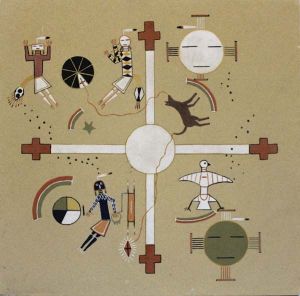
Navaho pollen path
So the little creation of 1's own life and the macrocosm of the world's life are in some manner to be coordinated. Well, for instance, amid the Navaho Indians, healing ceremonies were conducted by mode of sand paintings, which were by and large mandalas, on the footing and then the person who is to be treated moves into the mandala. There volition be a mythological context that he will be identifying with, and he identifies himself with that power. And this thought of sand painting with mandalas and used for meditation purposes appears also in Tibet in the corking Tantric monasteries outside of Lhasa. For instance, Rgyud Stod, they good sand painting, cosmic images and so along indicating the forces of the spiritual powers that operate in our lives.
Pecker MOYERS: Now, what do y'all brand or that, that in 2 very unlike cultures, the same imagery emerges?
JOSEPH CAMPBELL: Yep, well, at that place are just two ways to explain it, and one is by diffusion, that an influence came from there to here, and the other is by divide development. And when you have the idea of separate development, this speaks for certain powers in the psyche which are common to all mankind. Otherwise y'all couldn't accept — and to the detail the correspondences can be identified, information technology's astonishing when one studies these things in depth, the degree to which the agreements go between totally separated cultures.
Nib MOYERS: Which says something about the commonality of the species, doesn't it?
JOSEPH CAMPBELL: Well, yes, that was Carl Jung'southward idea, which he calls the archetypes, archetypes of the collective unconscious.
Nib MOYERS: What exercise you hateful by archetypes?
JOSEPH CAMPBELL: An archetype is a abiding form, a bones cardinal form which appears in the works of that person over there, and this person over here, without connecting them. They are expressions of the structure of the man psyche.
Bill MOYERS: So if you find in a diversity of cultures, each one telling the story of creation or the story of a virgin birth or the story of a savior who comes and dies and is resurrected, yous're saying something about what is inside us and the need to sympathise.
One can say that the images of myth are reflections of spiritual and depth potentialities of every i of u.s.. And that through contemplating those, we evoke those powers in our own lives to operate through ourselves.
JOSEPH CAMPBELL: That'due south right. One tin can say that the images of myth are reflections of spiritual and depth potentialities of every one of us. And that through contemplating those, nosotros evoke those powers in our own lives to operate through ourselves. In that location was a very important anthropologist — he'south the ane with whom my works brainstorm, you might say, my studies — Bastian in Deutschland, end of the last century and commencement part of this. He was a world traveler and recognized very soon that there were certain motifs that appeared in all of the religions and all of the mythologies of the earth. Such an thought, for example, as a spiritual power, that'southward an archetypal image that appears everywhere. And he called these "elementary ideas." But they appear in very different forms and different provinces and at unlike times, and those different forms are costumes he called ethnic or folk ideas. But within the ethnic idea is the uncomplicated idea, and it is those elementary ideas that Carl Jung then began studying and called "archetypes of the unconscious." When you lot say elementary idea, they seem to come from up here. When you say archetypes of the unconscious, they come from upward here, and they appear in our dreams, likewise every bit in myths.
BILL MOYERS: So when one scripture talked about beingness fabricated in his image, in God'south prototype, it's being, information technology'southward being created with certain qualities that every human existence possesses, no thing what that person's faith or culture or geography or heritage.
JOSEPH CAMPBELL: God would be the ultimate elementary idea of man.
BILL MOYERS: The key demand.
JOSEPH CAMPBELL: And we are all made in the paradigm of God, okay? Then that is the ultimate unproblematic idea or archetype of homo.
Beak MOYERS: I feel stronger in my own religion, knowing that others had the same yearnings and were seeking for the same images to try to express an experience that couldn't be costumed in ordinary human language.
JOSEPH CAMPBELL: That's right.
Pecker MOYERS: I feel much more kinship with all those who follow other means, because information technology seems…
JOSEPH CAMPBELL: This is why clowns are good.
BILL MOYERS: Clowns?
JOSEPH CAMPBELL: Clown religions, because they show that the image is not a fact, simply information technology's a reflex of some kind.
BILL MOYERS: Then does this aid explain the trickster gods that show upward at times?
JOSEPH CAMPBELL: They're very much that, yes. Some of the best trickster stories are associated with our American Indian tales. Now, these figures are clownlike figures, and nevertheless they are the creator god at the same time, very frequently. And this makes the point, I am not the ultimate image. I am transparent to something. Through me, through my funny form, and mocking information technology, and turning it into a grotesque action, y'all actually get the sense which, if I had been a big sober presence, you go stuck with the image.
BILL MOYERS: There's a wonderful story in some African tradition of the god who's walking down the road, and the god has on a hat that is colored reddish on one side and blueish on the other side. So when the people, the farmers in the field go into the village in the evening, they said, "Did you come across that young man, that god with the blue hat?" And the others said, "No, no, he had a red hat on," and they get into a fight.
JOSEPH CAMPBELL: Yes. He even makes it worse past first walking along this direction, and then turning around and turning his hat around, so that once more, it'll be cherry-red and black or whatever then when these two chaps fight and are brought earlier the rex or chief for judgment, this fellow appears and he says, "It's my fault, I did it. Spreading strife is my greatest joy."
BILL MOYERS: And there'south a truth in that…
JOSEPH CAMPBELL: There sure is, yeah.
BILL MOYERS: Which is?
JOSEPH CAMPBELL: No matter what system of thought you have, it can't possibly include boundless life. And when you lot think everything is just that way, the trickster comes in and it all blows, and you lot get the becoming thing once more. Now, Jung has a wonderful saying somewhere that, "Religion is a defense against a religious experience."
Nib MOYERS: Well, you lot accept to explain that.
JOSEPH CAMPBELL: Well, that means it has reduced the whole thing to concepts and ideas, and having the concept and thought curt-circuits the transcendent experience. The experience of deep mystery is what one has to regard equally the ultimate religious feel.
Nib MOYERS: Well, there are many Christians who believe that to discover out who Jesus is, y'all have to go past the Christian organized religion, by the Christian doctrine, by the Christian church building. And I know that's heresy to a lot of people, merely…
JOSEPH CAMPBELL: Well, you have to become past the prototype of Jesus. The paradigm of God becomes the final obstacle. Your God is your ultimate bulwark. This is basic Hinduism, bones Buddhism. Y'all know, the idea of the ascension of the spirit through the centers, the chakras, as they call them, or lotuses, the different centers of experience. The animal experiences of hunger and greed or merely the zeal of reproduction or the physical mastery of ane kind or another, these are all stages of ability. But then when the center of the center is reached, and the sense of compassion on another person, mercy and participation, and I and you are in some sense of the same being this is what marriage is based on in that location's a whole new stage of life experience opens upwardly with the opening of the heart.
And this is what's called the virgin birth, actually, the birth of a spiritual life in what formerly was but a human fauna, living for the animal aims of health, progeny, wealth and a little fun. Only at present you come up to something else: to participate in this sense of accord with another, or accord with some principle that has lodged in your mind as a skilful to be identified with, then a whole new life comes. And this is in Oriental thinking, the awakening of the religious experience.
And so this tin go on even to the quest for the feel of the ultimate mystery, that is, the ultimate mystery can exist experienced in two senses, ane without form and the other with course. And in this Oriental thinking, you experience God with form here, this is heaven, that's the identification with your own being, because that which God refers to is the ultimate mystery of beingness, which is the mystery of your existence as well every bit of the world, so it's…this is it.
BILL MOYERS: How do you lot explain what the psychologist Maslow calls "peak experiences," and what your friend James Joyce called epiphanies. I dearest that word, epiphany.
JOSEPH CAMPBELL: Oh, well, they're not quite the same, just…
Pecker MOYERS: I know.
JOSEPH CAMPBELL: The height feel refers to bodily moments of your life when you feel that this has told you something, something has come through in your feel of your relationship to the harmony of being. It can come…my peak experiences, I mean, the ones that I knew were peak experiences later on I had them, all came in athletics.
BILL MOYERS: Which was the Everest of your experience.
JOSEPH CAMPBELL: Yes, well…
BILL MOYERS: Which ane was information technology, was it when you were running at Columbia?
JOSEPH CAMPBELL: Yes, of course. And I ran a couple of races that were just beautiful, and the whole race, I knew I was going to win and there was no reason for me to know I was going to win, because I was touched off anchor in the relay with the start homo 30 yards ahead of me, and I just knew, knew, information technology was a peak experience. Nobody could shell me today. That'due south a kind of being in full form and really doing it. I don't call up I've ever done anything in my life as competently equally I ran those two races. And those consequently were the experience of really being at my full and doing perfect job. I don't call back I've ever had anything like that, quite, that I really came upwardly to anything quite that fashion.
Pecker MOYERS: Do you think you lot, Joseph Campbell, have to…it has to be physical?
JOSEPH CAMPBELL: No, but it tin be a peak experience there are other kinds of peak experiences, which I know were superior to those, but those are the ones that when I read Maslow and read of peak experience, I merely know that those were summit experiences.
Pecker MOYERS: What about James Joyce's epiphanies?
JOSEPH CAMPBELL: Now, that'southward another matter. This has to do with the esthetic experience. Joyce's formula for the esthetic feel is that it does not move you to want to possess the object, that he calls pornography; nor does it movement you to criticize and reject the object, that he calls didactics, social criticism in art and all that kind of thing. It is the holding the object, and he says you put a frame around it and come across it as i thing, and so seeing information technology as one thing, you go aware of the relationship of part to part, the role to the whole and the whole to each of the parts. This is the essential esthetic gene rhythm, the rhythm, the rhythmic relationships. And when a fortunate rhythm has been struck by the artist, at that place is a radiance. That'southward the epiphany. And that is what would be the Christ coming through, do yous sympathise what I'thou saying?
Neb MOYERS: The face up of the saint beholding God.
JOSEPH CAMPBELL: And it doesn't thing who information technology is. I mean, you lot could take someone who you would retrieve of as beingness a monster, that is an ethical judgment on the life, and this is transcendent of ethics, no pedagogy.
Nib MOYERS: But see, that's where I would disagree with you lot, because it seems to me in order to experience the epiphany, that which yous behold but exercise not want to possess must be cute in some way. A moment agone, when y'all talked nigh your peak experience, running, you lot said it was cute. Beautiful is an esthetic word.
JOSEPH CAMPBELL: Yeah, that'southward right.
BILL MOYERS: And how tin y'all behold a monster?
JOSEPH CAMPBELL: I tell you lot, in that location's some other emotion associated with fine art which is not of the beautiful, but of the sublime. And what we telephone call monsters tin can be seen as sublime. And they correspond powers also great for the mere forms of life to survive. Prodigious area of space is sublime. This is a matter that the Buddhists know how to achieve in their temples. Particularly when I was in Kyoto, I was there for vii glorious months.
BILL MOYERS: In Nihon.
JOSEPH CAMPBELL: Yeah, visiting some of the temple gardens. They are and so designed that you're experiencing something here, then you break by a screen and a whole new horizon opens out. And somehow with the diminishment of your own ego, the consciousness expands. This is the experience of the sublime. Another experience of the sublime is non of tremendous infinite, just of tremendous energy and power. And I have known a couple of people who were in central Europe during the saturation bombings that were conducted over those cities, and there was the…you merely have the experience of the sublime there.
BILL MOYERS: I once interviewed a veteran of the Second Earth State of war, and I was talking to him about his experience at the Battle of the Burl, with the set on of the Germans nigh to succeed. And I said, "Well, as you look back on it, what was it?" And he said, "It was sublime."
JOSEPH CAMPBELL: And so the monster comes through at that place.
BILL MOYERS: What practise y'all mean past monster?
JOSEPH CAMPBELL: Well, by a monster I mean someone who breaks all of your standards for harmony and for upstanding carry.
Nib MOYERS: Is in that location a story in mythology that illustrates the sublime in the monster?
JOSEPH CAMPBELL: Well, the god of the end of the world, Vishnu, at the end of the world is a monster. I mean, good night, he'southward destroying the world, beginning with fire and then with a torrential flood that drowns out the fire and everything else and nothing'south left simply ash, the whole universe has been wiped out. That'south God.
Bill MOYERS: Well, the Christian millennialists talk of the rapture.
JOSEPH CAMPBELL: Well, read Chapter xiii in Mark.
BILL MOYERS: Which says?
JOSEPH CAMPBELL: That's the end of the world. You encounter, these are experiences that go past ethical judgments. Ideals is wiped out. Our religions, with the accent on the human, equally I mentioned a little while ago, also stress the ethical. God is good. God is horrific the end of the earth? There's an Arab proverb that I read somewhere in The Arabian Nights that the angel of death, when the angel of death comes it is terrible; when he has reached you, it is bliss.
Now, in the Buddhist systems, particularly every bit we get them from Tibet, the Buddhas appear in two aspects; in that location is the peaceful aspect and there is the wrathful aspect of the deity. At present, if you're clinging to your ego and its trivial globe and hanging on, and the deity wants to open you, the wrathful attribute comes. It seems to you terrible. But if you are open, and open plenty, and then that same deity would exist experienced as bliss.
Beak MOYERS: Well, Jesus talked of bringing a sword, and I don't believe he meant that in terms of using it against your fellow [man], but he meant it in terms of opening the ego, I came to cut yous free from the blinding ego of your own self-centeredness.
JOSEPH CAMPBELL: This is what's known in Sanskrit as Viveka, discrimination, and there is a Buddha figure called Manjushri, who volition be…who's shown with a flaming sword over his head.
BILL MOYERS: Yeah.
JOSEPH CAMPBELL: And what is the sword for? It'south to distinguish the simply temporal from the eternal. It's the sword that distinguishes that which is enduring from that which is only passing. The tick-tick-tick of time shuts out eternity, and we alive in the field of fourth dimension. But what is living in the field of time is an eternal principle that'south inflected this fashion.
BILL MOYERS: What's the eternal principle?
JOSEPH CAMPBELL: Brahman.
Bill MOYERS: Which is?
JOSEPH CAMPBELL: Well, nosotros telephone call information technology God, but that personifies it, do y'all see. That's…
BILL MOYERS: Information technology is the experience of eternity.
JOSEPH CAMPBELL: Yeah.
Bill MOYERS: The feel of the eternal.
JOSEPH CAMPBELL: As what you lot are.
Bill MOYERS: Yes.
JOSEPH CAMPBELL: I would say, that's…
BILL MOYERS: That whatever eternity is, is here right at present.
JOSEPH CAMPBELL: And nowhere else, or everywhere else. If you don't feel it now, you're never going to get it. Because when you get to heaven, that'south not eternal, that's only everlasting. Heaven lasts a long time; it's not eternal, it'due south everlasting.
Nib MOYERS: I don't follow that, now.
JOSEPH CAMPBELL: The eternal is beyond time; the concept of time shuts out eternity.
BILL MOYERS: Time is our invention.
JOSEPH CAMPBELL: Our experience, yeah. Just the ultimate, unqualified mystery is beyond human experience, it becomes inflected. Every bit they say, there is a condescension on the role of the infinite to the mind of homo, and that is what looks like God.
Beak MOYERS: So whatsoever information technology is we experience, nosotros have to limited in language that is only not up to the occasion.
JOSEPH CAMPBELL: That'south it.
Bill MOYERS: It's inadequate.
JOSEPH CAMPBELL: That's what poetry is for. Poetry is a linguistic communication that has to be penetrated, it doesn't shut yous off, it opens, it's the rhythm, the precise choice of words that will have implications and suggestions that go past the discussion, is what has to happen. And so yous get what Joyce calls the radiance, the epiphany. The epiphany is the showing through of the essence, what Aquinas called the quidditas, the whatness. The whatness is the Brahman.
Bill MOYERS: Why practise you remember it is there is in so many people this deep yearning to live forever, to secure my place in heaven?
JOSEPH CAMPBELL: When yous realize what heaven is, I mean, in the works of such persons every bit Thomas Aquinas, information technology is the beholding of the beatific image of God, which is a timeless moment, y'all know, time explodes. And so over again, eternity is not something everlasting, and yous tin can have information technology right here now in your relationships. I've lost a lot of friends, and my parents and all, and a realization that has come to me very, very keenly is that I haven't lost them, that that moment when I was with them had an everlasting quality nearly it that is at present still with me. What it gave me is still with me. And there's a kind of intimation of immortality in that. Do yous run across what I mean?
Now, there's a wonderful work of Schopenhauer's; he says, "When y'all reach a certain age," and he wrote this when he was in his 60s or so, "and look back over your life, information technology seems to have had an lodge. It seems to have had been equanimous by someone. And those events that when they occurred seemed simply accidental and occasional and merely something that happened, plough out to be the chief elements in a consistent plot." So he says, "Who composed this plot?" And he said, "And but as your dreams are composed by an attribute of yourself, of which your consciousness is unaware, so your whole life has been composed by the volition within you lot." Then he says, "Just as those people whom you met past chance became effective agents in the structuring of your life, and then you take been an agent in the structuring of other lives, and the whole thing gears together similar one big symphony," he says, "everything influencing and structuring everything else." And he said, "It's every bit though our lives were the dream of a single dreamer, in which all the dream characters are dreaming too, and so everything links to everything else, moved out of the will in nature."
That'south a cute idea. It's an idea that occurs in India, in the image of what's called the "Nee of Indra" or the internet of gems. Where it's a net of gems where every gem reflects all the other ones. And they also have the idea of a spontaneous and simultaneous arising. Everything arises in relation to everything else, and then y'all can't arraign anybody for annihilation; it's all working around. Information technology's a marvelous thought. It'southward as though in that location were an intention behind information technology, and yet it all is past chance. None of united states has lived the life that he intended.
BILL MOYERS: And yet we all have lived a life that had a purpose. Do you believe that?
JOSEPH CAMPBELL: I don't believe life has a existent purpose. I mean, when you actually see what life is, it'southward a lot of protoplasm with an urge to reproduce and continue in being.
Pecker MOYERS: Not true. That's, not true, you…
JOSEPH CAMPBELL: Well, now, wait a minute. Just sheer life can't be said to accept a purpose, because look at all the different purposes it has all over the lot. But each incarnation, y'all might say, has the potentiality and the function of life is to live that potentiality. Well, how do yous do it? Well, again when my students would enquire, you know, should I do this, should I practise that? Dad says I should do this, and my answer is, follow your bliss. There'southward something inside you lot that knows you're in the center, that knows you're on the beam, that knows you're off the beam. And if you become off the beam to earn coin, you've lost your life.
Nib MOYERS: So it is non the destination that counts, information technology's the journeying.
JOSEPH CAMPBELL: Yep. There is a wonderful one-time homo, I retrieve he's, notwithstanding alive, in Frg, the Graf Karlfried, Karlfried Graf Durckheim. And he says, "When yous're on a journeying and the end keeps getting farther and farther away, and then you lot've realized that the real end is the journey." That'southward not bad. This is it, this moment now is the heavenly moment, and…
Bill MOYERS: I like the idea that Eden was not: Eden will be.
JOSEPH CAMPBELL: Eden is. "The kingdom of the male parent is spread upon the earth, and men exercise non encounter information technology" I mean, Eden is.
Pecker MOYERS: At that place's some paradigm of Shiva, the god Shiva surrounded by circles of flames, rings of burn.
JOSEPH CAMPBELL: That's the dance of the globe, the dancer whose dance is the universe. And in this hand he has a fiddling drum that goes tick-tick-tick. That is the drum of lime. The tick of time, which shuts out eternity, and we are enclosed in that. In this hand there is a flame, which burns away the veil of time and opens us up to eternity. And in his pilus is a skull and a new moon, the expiry and rebirth at the same moment, the moment of condign.
BILL MOYERS: That'due south a powerful image for any life, not just…
JOSEPH CAMPBELL: Well, the goal of your quest for yourself is to observe that burning point in your betoken, that becoming thing in yourself, which is fearless and desireless, but simply becoming. This is the condition of warrior going into boxing with perfect courage. That'due south life in motility. A plant growing, I think of grass, you know. Every two weeks a chap comes out with a lawn mower and cuts it down. Suppose the grass were to say, well, for Pete'due south sake, what's the utilise? Information technology's the coming into existence that'south it, and that'south the life indicate in y'all, and that's what these myths are concerned to communicate to you.
Neb MOYERS: Well, I've e'er interpreted that powerful, mysterious argument, "The Word was fabricated flesh," as the eternal principle finding itself in the homo journey, the human experience.
JOSEPH CAMPBELL: Yep.
BILL MOYERS: At present, I don't know what the Word is, and I don't even know what flesh is, but I know that there is that experience of epiphany, when you run into what you don't know and understand it.
JOSEPH CAMPBELL: Yeah, and y'all can find information technology in yourself, too, the Word in yourself.
BILL MOYERS: Where practice you discover it, if yous don't find it in yourself?
JOSEPH CAMPBELL: Well, right. Goethe says, "All things are metaphors." Alles vergangliche ist nur ein gleiches." Everything that's transitory is but a metaphorical reference. That'south what we all are, and to run into the Word, getting back to that, your radiance that we spoke of before comes out here again now.
BILL MOYERS: But how does one worship a metaphor, love a metaphor, dice for a metaphor?
JOSEPH CAMPBELL: Well, that'due south what people are doing all over the place. That'southward what people are doing all over the identify, dying for metaphors. And when y'all really realize the sound Aum, the sound of the mystery of the Word everywhere, then you don't have to get out and die for anything, because information technology's correct there all effectually, and just sit notwithstanding and see it and experience it and know it.
Neb MOYERS: Explain "Aum." That'south the first fourth dimension you've used that.
JOSEPH CAMPBELL: Well, "Aum" is a word that, what tin can I say, represents to our ears that audio of the energy of the universe, of which all things are manifestations. And "Aum", information technology's a wonderful word, it'due south written A-U-Thousand. Y'all start in the dorsum of the oral cavity, Ah, so, Ooh, you fill the oral cavity, and M-m-m, closes it, the mouth. And when you have pronounced this properly, all vowel sounds are in that pronunciation: "Aum". And consonants are regarded simply as interruptions of "Aum", and all words are thus fragments of "Aum", as all images are fragments of the form of forms, of which all things are only reflections. And then "Aum" is a symbol, a symbolic audio, that puts you in touch with that throbbing beingness that is the universe.
And when you hear some of these Tibetan monks that are over here from the Rgyud Stod monastery outside of Lhasa, when they sing the "Aum," you know what information technology means, all right That's the zoom of being in the earth. And to be in touch on with that and to get the sense of that, that is the peak experience of all. "Ab-ooh-mm." The nascence, the coming into beingness, and the solution to the wheel of that. And information technology'southward just called the four-chemical element syllable. What is the fourth element? "Ah-ooh-mm," and the silence out of which it comes, back into which it goes, and which underlies it.
Now, my life is the "Ah-ooh-mm," but there is a silence that underlies it, and that is what we would call the immortal. This is the mortal, and that'southward the immortal, and there wouldn't be this if there weren't that.
BILL MOYERS: The meaning is substantially wordless.
JOSEPH CAMPBELL: Aye. Well, words are always qualifications and limitations.
BILL MOYERS: And yet, Joe, all we puny human beings are left with is this miserable linguistic communication, beautiful though it is, that falls short of trying to describe…
JOSEPH CAMPBELL: That'due south correct And that'south why it's a superlative feel to break past all that every now and so, to realize "oh, ah," I retrieve so.
See all features related to Joseph Campbell and the Power of Myth.
Visit the Joseph Campbell Foundation website.
Downloadable and streaming versions of The Power of Myth are bachelor at PowerofMyth.net.
- More about Joseph Campbell
Source: https://billmoyers.com/content/ep-6-joseph-campbell-and-the-power-of-myth-masks-of-eternity-audio/
0 Response to "You Get That Becoming Thing Again"
Post a Comment