Carrie Mae Weems in Art on the Mind Bell Hooks
A s the news bike regularly demonstrates, the unproblematic, quintessentially modern human action of taking a photo has now get a predominant way of subverting entrenched power. And female artists, ofttimes on the fringes of cultural society, have been using their cameras to exercise just that for well over 100 years. This is i of the provocative declarations fabricated by Our Selves: Photographs past Women Artists from Helen Kornblum, the Museum of Modern Art's empowering new showroom of piece of work by female person photographers from over 100 years and all around the world.
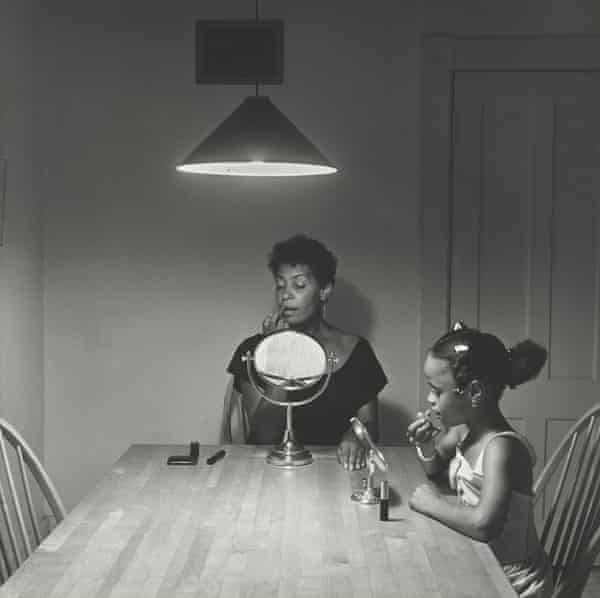
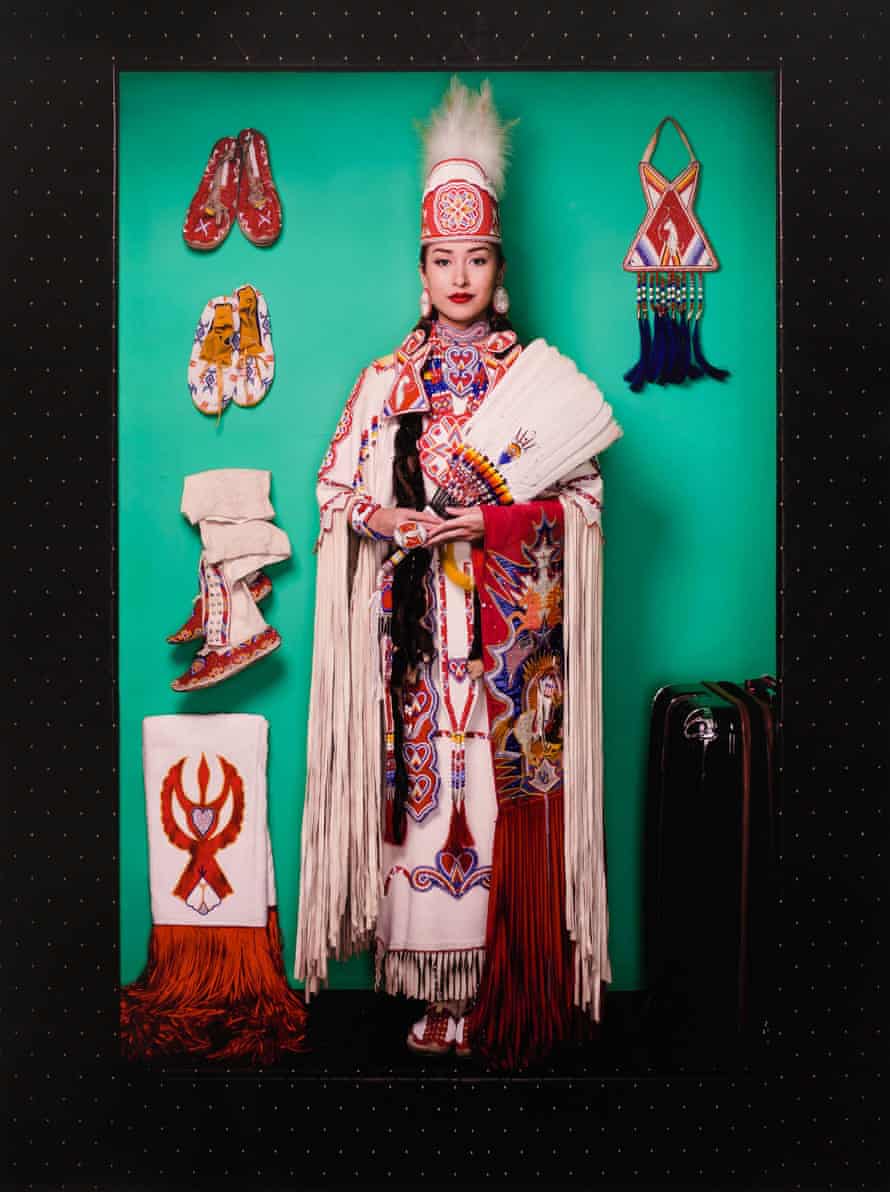
"For me it was interesting to constantly enquire the question what is a feminist picture, considering I got so many answers," showroom curator Roxana Marcoci told the Guardian. In fact, Our Selves provides 90 answers to this question, ranging from Frances Benjamin Johnston'southward 1899 photo of immature students in a penmanship class to Black photographer Carrie Mae Weem's 1990s "kitchen table" series. Feminist pictures also expect similar queer photographer Catherine Opie's work Angela Scheirl, which depicts the transgender artist Hans Scheirl years earlier he transitioned to male person, and Native American Cara Romero'south Wakeah, a 2018 portrayal of her friend Wakeah Jhane in full tribal apparel.
Yet even every bit Our Selves tin proudly declare that feminism supports a wide-ranging, inclusive idea of womanhood, Marcoci is mindful that this has non ever been the case. "As women take fought for sovereignty, they have not always included all women," she said. Indeed, this is one of the central questions that this show seeks to grapple with. "When I was conceiving of the exhibit, I was thinking almost, Ain't I a Woman?, bell hooks' blistering critique of first and second moving ridge feminism for sidelining women of color. So this was all underlying the exhibition as it was coming together."
Our Selves emerged from a deep-rooted collaboration between Marcoci and psychotherapist Helen Kornblum. For over xl years, Kornblum meticulously congenital a collection of photographs made past female artists, and a gift to the MoMA of many of these photographs comprises the cadre of Our Selves. This souvenir was the fruit of a longtime professional human relationship betwixt Marcoci and Kornblum: since 2014, they have served together on the MoMA's Committee on Photography, developing the museum's representation of female artists and pushing the museum to rethink dominant narratives handed downward by the patriarchal power structure. For Marcoci, this connection has been transformative. "When [Kornblum] joined the Committee on Photography, we instantly bonded on our work on women artists and women's rights. When I saw her photography collection for myself, I loved the vision that she had brought to it. It connected with my own interests and the MoMA's mission, to show arts that reflect a diversity of race and gender."
Our Selves stretches back to the late 19th century, and it pays due respect to the modernist movement that underlies and so many of the latter day artists it shows. The art here includes modernist greats similar Claude Cahun, Tina Modetti, and Lotte Jacobi, and it name-checks the likes of Leonora Carrington and Frida Kahlo. To these standard-bearers, Our Selves too adds lesser-known artists like Gertrud Arndt and Alma Levenson a collaborator of Ansel Adams, Imogen Cunningham, and Edward Weston. While these images are powerful in their own right, they also act equally a foundation, helping to situate and ground the more contemporary works on display throughout the show.
The theme of self-presentation is strongly prevalent throughout Our Selves, with so many of the pieces on display hither having been adult from intimate relationships betwixt lensman and subject. For instance, while looking at Romero'southward Wakeah – an image of a Native American woman covered head-to-toe in layers and layers of clothing – the subject offers a sense of vulnerability and display in spite of her voluminous dress. Romero's subject, a good friend, trusts the photographer to not do as and so many other photographers take done before when confronted with Native American dress and culture. Although her gaze is proud and potent, it lacks the wariness that comes with powerlessness and appropriation, instead subtly beckoning the viewer closer.
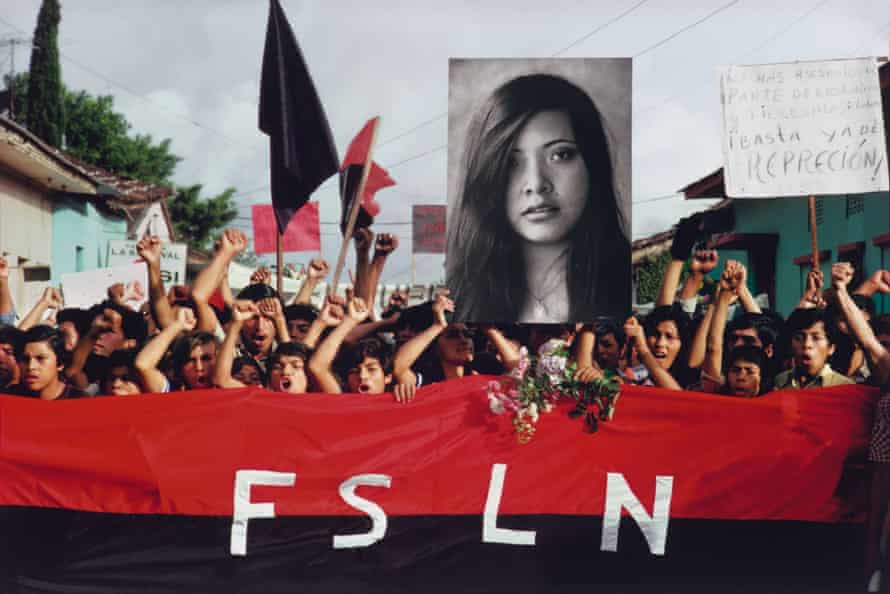
The gaze in Wakeah meets upwardly in interesting means with the gazes in the photographs past the American war photographer Susan Meiselas, demonstrating the exhibition'due south fascinating coherence, the photographs continually playing off one another. In Meiselas's aptly named Tentful of Marks, the camera is poised behind the two lithe, heeled legs of a carnival stripper, while one of the titular marks gazes up in awe at her, behind him and then many similarly fixated, zombified male faces. Those faces take on added significant when seen in conjunction with Meiselas'southward other contributions to the show: Traditional Mask Used in the Popular Insurrection, Monimbo, Nicaragua. That prototype shows an individual, presumably male, whose entire face and gaze is effaced by a mask of a mustachioed man that stares direct into the camera, the subject field's humanity but divers by one mitt resting furtively on a barbed wire fence. While Wakeah shows what is possible when ability relationships are momentarily left aside, Meiselas's photographs are about deconstructions of power relationships in full bloom. Together, all three enhance questions nigh gender, bodies, and who has the correct to gaze at whom.
Carrie Mae Weems'due south photograph Woman and Daughter with Makeup captures some other moment of profound gazing, when these power relationships are seemingly at bay, nonetheless are too quietly operative. The picture only depicts a Blackness woman and her girl simultaneously applying lipstick; the two be at in one case together and separately, as they eerily synchronize their movements yet exercise then while focusing intensely on their own mirror reflection, seemingly each in their own world. Marcoci told me that this photograph stood out to her for the way that Weems "places Black women at the forefront of the consequences of ability. Information technology'south such a moment of enacting beauty, synchronized operation, and yet nada is fetishized in this picture. It's an image of care, Black beauty, Black interiority … at that place'due south so much grace in how it's expressed."
Our Selves is worthy of applause for the respect information technology pays to women of various intersectional identities – non only does it celebrate artists like Weems and Romero, it also offers Catherine Opie'south transformational photographs of queer life, and the testify acknowledges its debts to postcolonial and queer theorists. Withal, all of this does make information technology disappointing that the bear witness contains no works by or of transgender women. Particularly at a time when many identifying as "feminists" are attempting to deprive transgender women of their safety, dignity, and basic rights – recalling the mode that prior waves of feminism sought to exclude not-white, non-heterosexual women – information technology would seem logical that an exhibition that prides itself on its inclusiveness and its dedication to all women's rights would desire to make its voice clear on this subject. It is the one false note in an otherwise glorious celebration of women and photography.
Much as Our Selves does to button frontwards important conversations and ideas for the hereafter of feminism, Marcoci is mindful that it is a part of a much larger struggle. "It'southward important to keep in mind that the work is never done," she said. "I know that I volition go along drawing attention to women artists and issues for the residuum of my professional life. Information technology's work of unlearning the histories that have been taught to u.s.a. in school and envisioning different narratives, like learning a new language basically."
-
Our Selves: Photographs by Women Artists from Helen Kornblum is now on display at the Museum of Modern Art in New York until two October
Source: https://www.theguardian.com/artanddesign/2022/apr/24/our-selves-celebrating-photographs-taken-by-female-artists
0 Response to "Carrie Mae Weems in Art on the Mind Bell Hooks"
Post a Comment